
Market signals for stablecoin payroll
Stablecoin payroll is shifting from experimental to standard practice for global teams in 2026. The primary drivers are lower transaction costs and near-instant settlement compared to traditional cross-border banking. USDC and USDT dominate this space, offering the liquidity necessary for routine payroll distribution.
Industry data indicates that 39% of crypto users worldwide already receive part of their income in stablecoins, with the average share at 35%. This adoption spans 15 countries, signaling a robust pattern rather than a niche trend. The reliability of these payments depends heavily on the stability of the underlying assets.
USDC vs USDT for payroll workflows
Choosing a stablecoin is primarily a compliance decision. While USDC and USDT dominate global liquidity, their regulatory foundations differ significantly. For employers, the choice dictates how auditors view reserve backing and jurisdictional risk.
Regulatory status and reserve transparency
USD Coin (USDC), issued by Circle, operates with higher regulatory transparency. Reserves are held in short-duration US Treasuries and cash, with monthly attestations from independent auditors. This structure aligns with emerging frameworks like the GENIUS Act and MiCA, which favor issuers with clear, segregated reserve structures.
Tether (USDT) remains the largest stablecoin by volume but faces scrutiny regarding reserve composition. While Tether publishes quarterly attestations, its historical lack of full transparency has led many institutional payroll providers to prefer USDC for its predictable legal standing. For global teams, USDC’s compliance-first approach reduces the risk of sudden de-pegging or regulatory freezes.
Supported chains and settlement costs
Both assets are available on major networks, but USDC has deeper integration with enterprise-grade infrastructure. It is native to Ethereum, Solana, and Algorand, with robust support on Polygon and Arbitrum. This breadth allows payroll providers to offer low-cost, near-instant settlements across multiple jurisdictions.
USDT is widely available but often relies on networks like Tron for high-volume transfers. While cost-effective, reliance on less regulated chains can introduce compliance hurdles for employers subject to strict AML/KYC requirements.
| Feature | USDC (Circle) | USDT (Tether) |
|---|---|---|
| Regulatory Status | High (MiCA/GENIUS Act aligned) | Moderate (Ongoing scrutiny) |
| Reserve Backing | US Treasuries & Cash | Diversified (incl. commercial paper) |
| Transparency | Monthly attestations | Quarterly attestations |
| Primary Payroll Chains | Ethereum, Solana, Algorand | Tron, Ethereum, BSC |
| Institutional Adoption | High (Enterprise focus) | High (Retail/Exchange focus) |
Employer risk assessment
For legal and compliance teams, USDC presents a lower risk profile due to its clear regulatory alignment and transparent reserve structure. Employers in heavily regulated jurisdictions (EU, UK, Singapore) often find USDC easier to justify in internal audits.
USDT’s market dominance ensures high liquidity, but its regulatory ambiguity can complicate tax reporting and anti-money laundering (AML) checks. Employers must weigh the convenience of USDT’s widespread acceptance against the potential legal costs of navigating its less transparent framework.
Compliance and tax implications in 2026
Paying employees in stablecoins does not remove the obligation to report compensation as income. Tax authorities in the United States, the European Union, and the United Kingdom treat cryptocurrency payments as property or income equivalent to fiat currency. The legal risk lies in treating digital assets as a regulatory gray area; they are not. Employers must calculate the fair market value of USDC or USDT at the moment of transfer to determine the taxable wage base.
The distinction between paying in crypto versus paying with crypto is critical. When you pay a contractor in USDC, the transaction is a taxable event for the recipient and a deductible expense for the employer, valued at the USD peg at the time of payment. Misclassifying these payments as non-taxable barter or gift transactions invites audits and penalties. The IRS and HMRC both maintain that the underlying asset’s volatility or stability does not change its classification as taxable compensation.
For global teams, the regulatory landscape is fragmented. The EU’s Markets in Crypto-Assets (MiCA) regulation provides clearer guidelines for stablecoin issuers but leaves payroll taxation to member states. In the US, the lack of federal stablecoin legislation means employers must navigate state-specific reporting requirements. Non-compliance risks include back taxes, interest, and potential criminal charges for willful evasion. Employers must implement robust tracking systems that capture the exact timestamp and exchange rate for every payroll transaction.
Using USDC and USDT for payroll offers speed and lower transaction costs, but it shifts the compliance burden onto the employer. You are responsible for issuing correct tax forms (such as 1099-NEC in the US) based on the stablecoin’s USD value at the time of payment. Failure to do so can result in severe penalties. The trend in 2026 is toward automation tools that integrate with payroll software to calculate and report these values in real time, ensuring accuracy and audit readiness.
The stability of USDC and USDT reduces exchange rate risk for the employee but does not eliminate the tax reporting requirement. Legal counsel should review payroll structures to ensure alignment with local labor and tax laws.
Top software platforms for automation
Selecting the right crypto payroll provider requires balancing automation capabilities with strict regulatory adherence. For global teams, the platform must handle multi-jurisdictional compliance while processing USDC and USDT efficiently.
Deel
Deel has established itself as a comprehensive solution for global workforce management. Its crypto payroll module integrates seamlessly with its existing Employer of Record (EOR) infrastructure, allowing companies to pay contractors in stablecoins while maintaining compliant local entity structures. This dual approach is particularly valuable for organizations navigating complex tax environments in Europe and Asia. Deel supports direct payouts in USDC and USDT, reducing settlement times to minutes. The platform’s automated tax withholding features help mitigate the risk of non-compliance in jurisdictions where crypto income is treated as standard wages.
Remote
Remote focuses on simplifying the legal complexities of international hiring. Its crypto payroll functionality is embedded within a broader suite of compliance tools, including automated contracts and benefits administration. Remote’s platform is designed for enterprises that require rigorous audit trails and standardized payroll processes across multiple countries. By supporting stablecoin payments, Remote enables faster capital deployment for global teams. The platform’s emphasis on legal compliance ensures that employers remain protected against local labor law violations, a critical factor when distributing digital assets.
Bitwage
Bitwage specializes in converting traditional fiat paychecks into cryptocurrency. This model is ideal for companies that already have established payroll systems but wish to offer stablecoin options to employees. Bitwage acts as an intermediary, receiving fiat funds from the employer and distributing USDC or USDT to employee wallets. This approach minimizes the need for companies to manage direct crypto treasury operations. Bitwage’s regulatory framework is built around existing financial services licenses, providing a layer of familiarity for traditional finance teams. The platform’s simplicity makes it a low-friction entry point for organizations testing crypto payroll adoption.
Chainalysis
Chainalysis provides the compliance infrastructure rather than direct payroll distribution. However, its KYT (Know Your Transaction) and KYM (Know Your Customer) tools are essential for any organization processing crypto payroll. By integrating Chainalysis, companies can screen employee wallets for sanctions lists and illicit activity before disbursing funds. This risk mitigation is critical for maintaining regulatory standing. While Chainalysis does not issue payments, its data feeds are often embedded within other payroll platforms, ensuring that stablecoin transactions meet anti-money laundering (AML) standards.
CryptoPayroll
CryptoPayroll is a dedicated platform focused exclusively on cryptocurrency compensation. It offers a straightforward interface for issuing stablecoin payments and generating tax reports. The platform supports both USDC and USDT, allowing flexibility in treasury management. CryptoPayroll’s reporting tools are designed to simplify the complex task of documenting crypto transactions for tax authorities. This focus on reporting accuracy helps reduce the administrative burden on finance teams. The platform’s simplicity makes it suitable for smaller teams or startups that require a dedicated crypto payroll solution without the overhead of broader HR software.
Implementation checklist for employers
Launching a stablecoin payroll program requires a structured workflow to mitigate legal exposure and operational errors. Employers must treat this not as a simple payment switch, but as a new compliance layer involving tax withholding, employee consent, and counterparty risk management.
Explicit consent is the foundation of any stablecoin payroll arrangement. Employers must obtain written opt-in agreements that clearly disclose the voluntary nature of the program, the specific stablecoins used (USDC or USDT), and the associated risks, including price volatility and transaction finality. This documentation serves as the primary defense against labor disputes and ensures compliance with local employment laws regarding wage payment methods.
Do not manage stablecoin transfers directly through corporate wallets. Engage a regulated payroll provider that offers built-in tax withholding, fiat conversion, and audit trails. These platforms act as the necessary intermediary, ensuring that stablecoin disbursements meet local regulatory standards for wage payments and providing the necessary reporting for tax authorities.
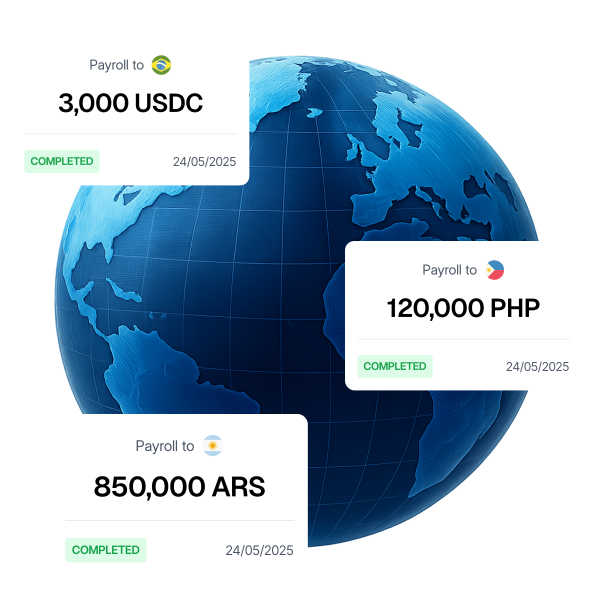
Stablecoin payroll must integrate seamlessly with existing tax frameworks. Configure the provider to automatically calculate and withhold federal, state, and local taxes before converting stablecoins to fiat or distributing them. Ensure the system generates accurate pay stubs and year-end tax forms (such as W-2s in the US) that reflect the fair market value of the stablecoins at the time of payment.
Before full deployment, run a pilot program with a small group of employees. This allows the finance and legal teams to verify that transaction fees are accounted for, that employees can successfully receive and convert funds, and that the payroll provider’s reporting is accurate. Use this phase to refine the employee onboarding process and address any technical glitches in wallet integration or notification systems.

Define clear protocols for failed transactions, network congestion, or stablecoin depegging events. The contingency plan should include immediate communication templates for affected employees and a fallback mechanism to pay in fiat if the stablecoin network experiences significant disruptions. Regularly review the provider’s uptime and security certifications to ensure ongoing reliability.
| Feature | Direct Wallet Transfer | Regulated Payroll Provider |
|---|---|---|
| Tax Withholding | Manual, high error risk | Automated, compliant |
| Audit Trail | Fragmented | Centralized, exportable |
| Liability | High employer exposure | Shared with provider |
| Employee Onboarding | Complex, DIY | Streamlined, guided |
Implementing stablecoin payroll is a significant operational shift. By following this checklist, employers can minimize risk while leveraging the efficiency of USDC and USDT for global teams.
No comments yet. Be the first to share your thoughts!