
What crypto payroll means in 2026
Crypto payroll in 2026 refers to the use of blockchain-based assets, primarily stablecoins, to compensate employees and contractors. While early experiments involved volatile cryptocurrencies like Bitcoin, the 2026 standard has shifted decisively toward stablecoin workflows. This transition addresses the primary friction point of earlier iterations: the inability to predict net pay when asset values swing wildly between approval and settlement.
The distinction between volatile asset payments and stablecoin payouts is no longer theoretical; it is a compliance necessity. Under frameworks like the Cryptoasset Reporting Framework (CARF), which took effect on 1 January 2026, reporting cryptoasset service providers must collect and report detailed transaction data to tax authorities such as HMRC. Paying staff in assets with high volatility introduces complex tax valuation challenges that stablecoins largely mitigate by maintaining a peg to fiat currencies.
To illustrate the stability required for reliable payroll, consider the price action of USDT against the US dollar. While Bitcoin experiences significant daily fluctuations, stablecoins are engineered to remain within a tight band, ensuring that an employee’s compensation retains its intended value from the moment it is authorized until it hits their wallet.
This shift toward stablecoin payroll is driven by the need for predictable settlement costs and regulatory clarity. As global payout mechanisms evolve, the focus remains on using digital assets for their efficiency and borderless nature, while stripping away the speculative risk that made crypto payroll untenable for most employers just a few years ago.
Regulatory shifts and tax reporting
The regulatory environment for crypto payroll is tightening significantly in 2026. Employers using cryptocurrency for compensation must navigate a new layer of compliance driven by international tax transparency standards. Two major frameworks dominate this landscape: the Cryptoasset Reporting Framework (CARF) and the Markets in Crypto-Assets (MiCA) regulation.
CARF implementation in the UK
From 1 January 2026, the Cryptoasset Reporting Framework (CARF) comes into force in the UK. This requires cryptoasset service providers to collect and report detailed information to HMRC about the tax residency of users and their transactions. For employers, this means that the payroll software or service provider handling crypto payouts must ensure they are capturing and transmitting the necessary tax data. Failure to comply can result in significant penalties and legal exposure.
MiCA and EU compliance
In the European Union, the Markets in Crypto-Assets (MiCA) regulation establishes a comprehensive framework for crypto-asset service providers. MiCA requires strict adherence to transparency, consumer protection, and financial stability rules. Employers operating within the EU must ensure their payroll providers are fully licensed and compliant with MiCA requirements. This includes robust anti-money laundering (AML) checks and clear disclosure of risks associated with crypto payments.
Impact on employer obligations
The convergence of CARF and MiCA places the burden of compliance squarely on the employer. You are no longer just paying salaries; you are facilitating taxable events that must be reported to tax authorities. This requires:
- Enhanced record-keeping: Maintain detailed logs of every crypto transaction, including the fair market value at the time of payment.
- Employee communication: Clearly inform employees about the tax implications of receiving crypto and how their data will be reported.
- Provider vetting: Ensure your payroll provider is compliant with both CARF and MiCA, as they are the primary reporting entities.
The shift from voluntary disclosure to mandatory reporting means that crypto payroll is no longer a niche practice. It is a regulated financial activity that requires the same level of diligence as traditional payroll. Ignoring these regulatory shifts is not an option for any business operating in the global crypto economy.
Crypto payroll software comparison
Selecting a platform requires balancing regulatory adherence with operational flexibility. The following analysis compares four leading providers—Gloroots, Papaya Global, Deel, and Bitwage—based on their native crypto handling, global compliance infrastructure, and Employer of Record (EOR) capabilities.
The Cryptoasset Reporting Framework (CARF) implementation in 2026 mandates rigorous data collection for tax residency and transaction reporting. Platforms that embed these reporting standards natively reduce the legal exposure associated with manual cross-border payments.
The table below outlines the core capabilities of each vendor. Gloroots and Bitwage focus primarily on payroll execution, while Papaya Global and Deel offer broader EOR ecosystems that include crypto settlement options.
| Vendor | Native Crypto Payroll | Global EOR | Stablecoin Support | Primary Compliance Edge |
|---|---|---|---|---|
| Gloroots | Yes | No | USDC, USDT | Automated tax reporting |
| Papaya Global | Partial | Yes | USDC | Global labor law |
| Deel | Partial | Yes | USDC, DAI | Contractor classification |
| Bitwage | Yes | No | BTC, ETH, USDC | Payroll integration |
Gloroots distinguishes itself by treating crypto as a first-class payroll citizen rather than an add-on. This approach simplifies the accounting ledger for finance teams but lacks the EOR infrastructure needed to hire employees in jurisdictions where direct employment is legally complex.
Papaya Global and Deel provide comprehensive EOR services, allowing companies to hire full-time employees in over 150 countries. Their crypto capabilities are often limited to specific regions or contractor payouts, requiring careful configuration to ensure stablecoin transfers do not trigger unintended tax events.
Bitwage operates as a middleware layer, integrating with existing payroll providers like ADP or Gusto. This allows organizations to maintain their current HR workflows while offering employees the option to receive a portion of their salary in cryptocurrency. This hybrid model is ideal for companies that need to comply with traditional payroll regulations while still offering crypto benefits.
Stablecoin vs. Volatile Asset Payouts
The choice between stablecoins and volatile cryptocurrencies for payroll fundamentally alters how a company manages FX risk and employee acceptance. While Bitcoin and Ethereum offer potential upside, they introduce significant volatility that complicates accounting and can deter employees who rely on predictable income for living expenses.
Stablecoins pegged to fiat currencies, such as the US Dollar, provide a predictable value at the time of payout. This stability simplifies payroll processing and reduces the administrative burden of frequent revaluation. Employees can use these tokens with greater confidence, knowing their purchasing power will not fluctuate wildly between pay periods. This predictability is critical for global teams operating in regions with high inflation or unstable local currencies.
Conversely, paying in volatile assets requires robust risk management frameworks. Companies must decide whether to convert crypto to fiat immediately upon payout or allow employees to hold the asset. Holding volatile assets exposes employees to market risk, which can lead to dissatisfaction if the value drops significantly before they can convert it. From a compliance standpoint, this also introduces complex tax reporting requirements, especially with frameworks like the Cryptoasset Reporting Framework (CARF) coming into force in 2026.
The decision often hinges on the company's risk appetite and the geographic location of its workforce. For most enterprises seeking operational simplicity and employee satisfaction, stablecoins offer a more pragmatic solution for global payroll. Volatile assets may be better suited for equity compensation or bonus structures where the potential for appreciation is a feature, not a bug.
Choosing the right payroll provider
Selecting a crypto payroll vendor requires matching technical capabilities to your organization’s specific risk profile. The decision hinges on three variables: team size, geographic distribution, and existing compliance maturity. A platform that works for a small, domestic remote team may fail catastrophically for a multinational enterprise subject to the Cryptoasset Reporting Framework (CARF).
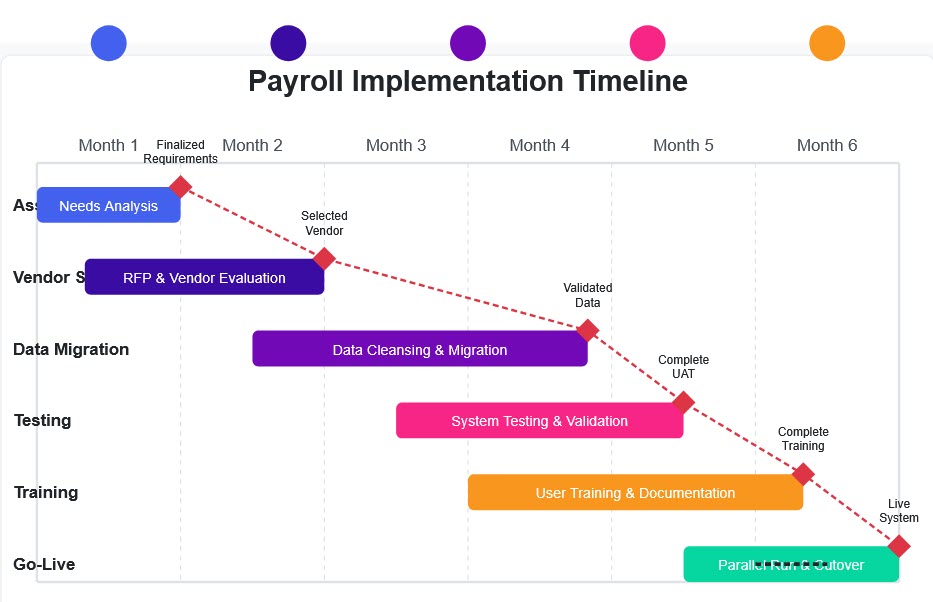
Prioritize providers with explicit support for local labor laws in your key jurisdictions. With CARF enforcement beginning in 2026, your vendor must automatically generate the required tax residency reports for HMRC and other tax authorities. Verify that the platform handles currency conversion reporting in the local fiat currency to avoid complex tax reconciliation for your accounting team.
Confirm the provider’s ability to settle payments in the specific stablecoins your employees prefer (e.g., USDC, USDT). The platform must maintain sufficient liquidity to process payroll on schedule without delays. Check whether the provider acts as a custodian or integrates with third-party wallets, as this determines your exposure to counterparty risk during market volatility.
Demand full transparency in transaction logging. Your provider should offer real-time dashboards showing every conversion, fee, and transfer. This data is critical for external audits and internal financial controls. Ensure the system exports data in formats compatible with your existing ERP or accounting software to streamline year-end reporting.
| Feature | Small/Single Country | Enterprise/Multi-Country |
|---|---|---|
| Tax Reporting | Basic fiat conversion | Automated CARF/local tax compliance |
| Settlement Speed | Standard (24-48h) | Real-time or instant |
| Support Level | Email/Chat | Dedicated compliance officer |
The right provider reduces administrative friction while ensuring legal safety. For organizations prioritizing stability, consider the current market performance of major stablecoins to understand settlement risks.
Frequently asked: what to check next
What is the new crypto law in 2026?
From 1 January 2026, the Cryptoasset Reporting Framework (CARF) comes into force. This international standard requires UK reporting cryptoasset service providers to collect and report detailed information to HMRC about the tax residency of users and their transactions, closing previous reporting gaps for payroll and payroll-adjacent crypto activities.
Is crypto payroll compliant with stablecoin regulations?
Stablecoin payroll is subject to specific regulatory frameworks like the GENIUS Act in the US and MiCA in the EU. Unlike volatile cryptocurrencies, stablecoins used for payroll must maintain strict reserve backing and transparency. Companies must ensure their payroll software supports these specific compliance layers to avoid regulatory penalties when settling employee wages in digital assets.
How do I choose a compliant crypto payroll vendor?
Selection should prioritize vendors with built-in tax withholding automation and integration with local payroll systems. Look for providers that explicitly support CARF reporting and offer real-time fiat conversion to mitigate volatility risk. Verify that the vendor maintains auditable records of all on-chain transactions to satisfy potential tax authority audits.
No comments yet. Be the first to share your thoughts!