
Define your crypto payroll scope
The first step in setting up crypto payroll is defining the precise scope of your compensation program. You must decide whether you are paying employees, independent contractors, or both. This distinction matters because the regulatory burden differs significantly. Employees are subject to withholding taxes, social security contributions, and labor laws that vary by country. Contractors typically receive payments as business-to-business transactions, which simplifies reporting but requires strict classification to avoid misclassification penalties.
Next, identify every jurisdiction where your payees reside. Crypto payroll is not a single legal obligation; it is a collection of local requirements. If you pay a developer in Portugal and a designer in Texas, you are navigating two entirely different tax systems. Each jurisdiction may treat cryptocurrency differently—some view it as property, others as a foreign currency, and some have specific reporting thresholds for digital asset transactions.
Clarifying these variables upfront determines your compliance roadmap. Without a clear scope, you risk missing withholding obligations or failing to report payments correctly. Start by listing every payee, their location, and their classification. This inventory forms the foundation for selecting the right payroll infrastructure and ensuring you meet all local regulatory requirements before the first payment is processed.
Choose the right stablecoin for wages
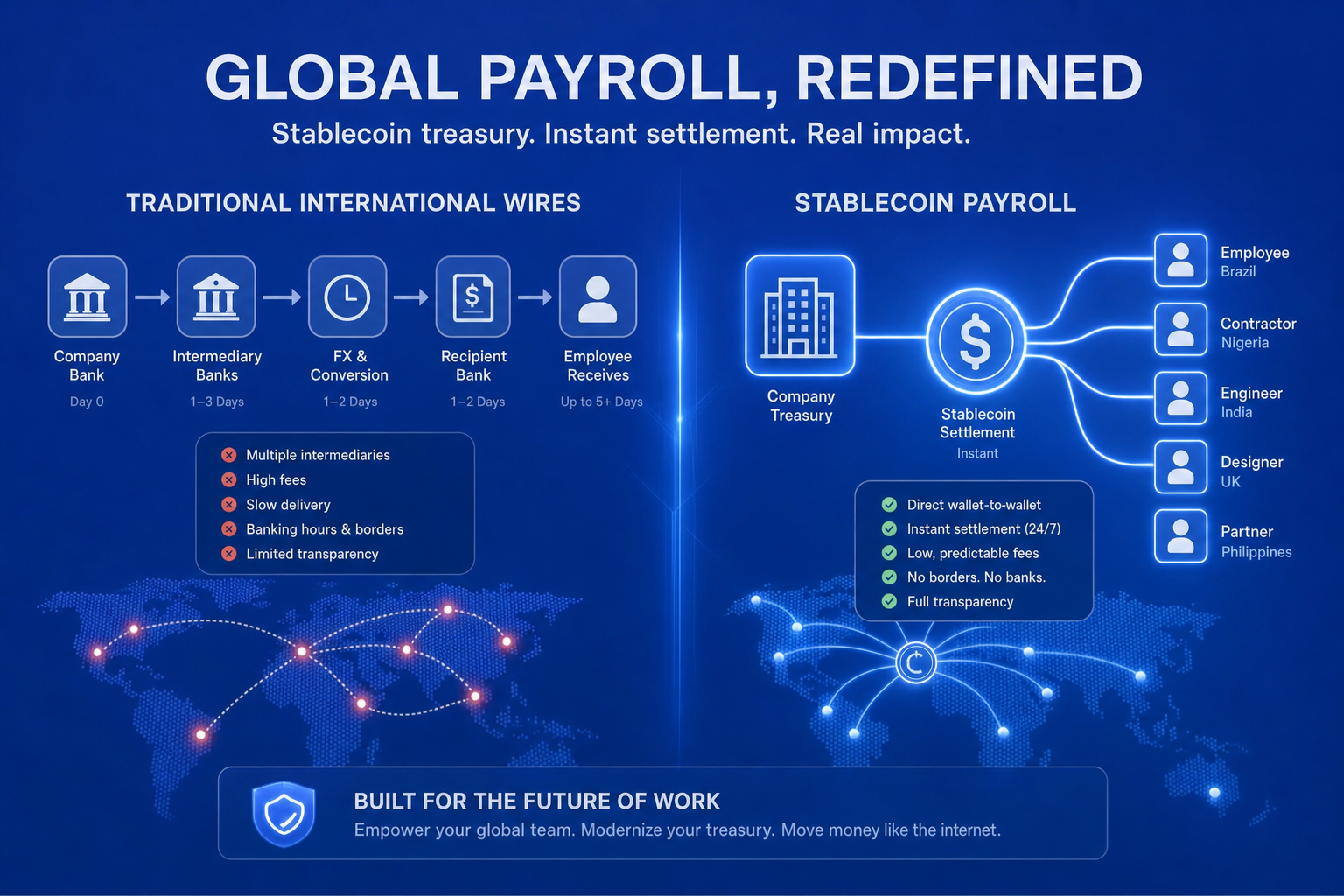
Bitcoin and Ethereum introduce unacceptable volatility for routine wage payments. A 5% daily swing can erode employee take-home pay and complicate payroll accounting. Stablecoins solve this by pegging value to fiat currencies, providing the predictability required for regular compensation cycles.
For global payroll in 2026, regulatory clarity is the primary selection criterion. The European Union’s MiCA framework and the proposed U.S. GENIUS Act establish specific standards for stablecoin issuers. Selecting a compliant asset ensures your payroll system meets reporting requirements and avoids regulatory friction.
Focus on widely accepted, fully reserved stablecoins. USDC and USDT dominate the market due to deep liquidity and established compliance frameworks. These assets integrate with most payroll providers and offer the settlement speed necessary for cross-border payments.

Verify the issuer’s reserve transparency. Reputable issuers publish monthly attestation reports confirming 1:1 backing with cash and short-term U.S. Treasuries. This transparency protects your company from counterparty risk and ensures employees can redeem their wages at face value.
Evaluate transaction costs and network speed. Ethereum-based stablecoins can incur high gas fees during peak times, reducing net pay. Consider layer-2 solutions or alternative chains like Solana for lower-cost, faster settlements, especially for smaller wage amounts.
Select a compliant payroll platform
Choosing a crypto payroll provider requires more than comparing transaction fees. In 2026, the primary differentiator is regulatory compliance. You need a platform that automates tax reporting and adheres to local labor laws, not just one that facilitates token transfers.
The market remains fragmented. While some providers focus on simple contractor payouts, others offer full Employer of Record (EOR) services that handle multi-jurisdictional compliance. Using a platform that lacks proper tax reporting capabilities exposes your business to significant liability.
Evaluate providers against these three compliance criteria:
- Automated Tax Reporting: The platform must generate required tax forms (e.g., 1099s in the US) automatically.
- Jurisdictional Coverage: Verify if the provider supports your specific country’s labor regulations.
- Stablecoin Support: Ensure the platform supports the stablecoins (like USDC) you intend to use for payroll.
The table below compares leading platforms based on these critical compliance factors.
| Platform | Automated Tax Reporting | Supported Stablecoins | Global Coverage |
|---|---|---|---|
| Deel | Yes (1099, VAT) | USDC, USDT | 150+ countries |
| Bitwage | Yes (1099, W-2) | BTC, ETH, USDC | 170+ countries |
| Eco | Partial (Self-service) | USDC, USDT, BTC | Global (Self-hosted) |
| Gloroots | Yes (Regional) | USDC | 100+ countries |
Configure tax withholding and reporting
Setting up crypto payroll requires more than just selecting a payment token; it demands strict adherence to local tax codes. The primary risk lies in the divergence between how tax authorities view digital assets and how software executes transactions. If your platform does not automatically calculate withholding based on the fiat value at the time of transfer, you will face significant compliance failures.
You must configure your payroll software to integrate directly with local tax authority APIs or generate reports in the exact format required by your jurisdiction. This ensures that withholding is captured accurately before funds are distributed.

Identify the tax treatment of crypto wages in each employee's location. In the US, the IRS treats cryptocurrency as property, meaning each payment is a taxable event. In the EU, VAT and income tax rules vary by member state. Configure your software to apply the correct withholding percentage based on the employee's registered tax residency, not their physical location.
Tax authorities require withholding calculations based on the fair market value of the asset at the moment of payment. Configure your payroll provider to use a real-time oracle or exchange rate provider to lock in the fiat value (USD, EUR, GBP) at the exact second of payout. This prevents discrepancies between the amount withheld and the amount reported to tax agencies.
Most jurisdictions require quarterly or annual filings (such as Form 941/944 in the US or P11D in the UK). Configure your crypto payroll platform to automatically generate these reports in the required format. Ensure the system logs the transaction hash, the fiat value at payout, and the tax amount withheld for each pay period.
Test the data flow between your payroll software and the local tax authority's submission portal. Some regions allow direct API integration for filing; others require manual upload of CSV files. Run a test payroll for a single employee and verify that the withholding data matches the expected output from the tax authority's calculator.
Crypto volatility can create discrepancies between withholding and final tax liability. Establish a quarterly reconciliation process to compare the withheld amounts against the actual tax liability calculated on the year-end tax forms (such as W-2s or P60s). Adjust future withholding rates if necessary to avoid underpayment penalties for employees.
Failure to configure these settings correctly can result in heavy fines. For instance, the UK's Finance Bill proposes strict penalties for reporting entities that fail to submit required information timely. Ensure your software's reporting engine is tested and validated before your first live payroll run.
Onboard employees and test payouts
Before processing live wages, you must establish a verified digital identity for each employee and confirm that funds can move from your corporate treasury to their personal wallets. This phase bridges your internal compliance checks with the employee’s ability to access their crypto payroll. Skipping verification or test runs creates immediate tax ambiguity and potential loss of funds.

Initiate a Know Your Customer (KYC) process through your payroll provider. This step satisfies anti-money laundering (AML) regulations and ensures the recipient matches the payroll records. Collect the employee’s public wallet address for the chosen cryptocurrency (e.g., BTC, ETH). Verify the network compatibility to prevent funds from being sent to an unsupported chain. Do not accept private keys; only public addresses are required for payouts.
Define the payment schedule (weekly, bi-weekly, or monthly) and the specific cryptocurrency allocation. If offering fiat-on-ramp integration, configure the automatic conversion rates or stablecoin preferences. Ensure the employee acknowledges the volatility risk and tax implications of receiving digital assets. Document this consent in your HR records to protect against future regulatory disputes.
Send a minimal amount (e.g., $10 equivalent) to the employee’s verified wallet address. This confirms that the address is active, the network is functioning, and the employee can successfully receive and view the funds. Monitor the transaction on the blockchain explorer to ensure confirmation. If the transaction fails, the employee or your provider will receive an error message that must be resolved before proceeding.
Once the employee confirms receipt of the test funds, mark their profile as "active" in your payroll system. Schedule the first live payout according to the configured frequency. Maintain a separate ledger for crypto transactions to facilitate accurate tax reporting. Notify the employee that their payroll is now live and provide instructions for accessing their funds or converting them to fiat if necessary.
FAQs about crypto payroll 2026
What is a crypto payroll?
Crypto payroll is the practice of compensating employees or independent contractors using blockchain-based digital assets rather than traditional fiat currency. While Bitcoin is the most common asset for these transactions, compliant platforms also support Ethereum (ETH), Litecoin (LTC), Solana (SOL), and Cardano (ADA). This method replaces standard bank rails with on-chain settlements, requiring businesses to handle specific tax withholdings and reporting duties.
What is the Budget 2026 date for crypto reporting?
Under the proposed Finance Bill, a new compliance deadline takes effect on April 1, 2026. From this date forward, crypto exchanges and platforms must submit timely statements of user transactions to the income tax department. Failure to meet this reporting obligation triggers a financial penalty: platforms will face a fine of Rs 200 per day for every day they remain non-compliant with the submission requirements.
Is crypto payroll legal in the US?
Using cryptocurrency for payroll is generally legal in the United States, provided the employer follows existing federal and state regulations. The IRS treats cryptocurrency as property, meaning transactions must be reported in fair market value at the time of payment. Employers must withhold income tax and pay Social Security and Medicare taxes (FICA) on these payments. Non-compliance with tax reporting can result in significant penalties, even if the underlying currency transfer is valid.
No comments yet. Be the first to share your thoughts!