


Remote teams thriving across borders face a stark reality: traditional payroll systems drain resources through foreign exchange fees and glacial settlement times. Companies routinely absorb 3-8% in costs per international wire, with delays often spanning 3-5 business days, as highlighted in recent analyses from Ogletree and Toku. USDC payroll flips this script, leveraging a stablecoin fixed at $1.00 to deliver near-instant global salaries without the volatility risks or compliance headaches of other cryptos. For startups and tech firms scaling worldwide, this means reallocating savings to growth rather than banks.

Consider the data: as of April 1,2026, platforms like Riseworks and Toku have normalized USDC for payroll, integrating with HR giants such as ADP and Workday. Circle’s own insights underscore USDC as a superior rail for cross-border business payments, cutting costs while boosting speed. In my decade-plus tracking digital assets, I’ve seen few innovations match this blend of stability and efficiency for USDC payroll.
Quantifying the FX Fee Drain in Cross-Border Payroll
Let’s dissect the numbers. A mid-sized remote-first company with 50 global contractors might face $150,000 annually in FX and wire fees alone at 5% average rates on a $3 million payroll. Processing lags compound this, exposing firms to currency swings; a 2% euro depreciation mid-transfer erodes another chunk. Sources like TransFi peg traditional fees at 3-8%, corroborated by Riseworks’ breakdowns. Blockchain transparency via USDC eliminates these opacity traps, settling on networks like Polygon in seconds for fractions of a cent.
Traditional Wires vs USDC Payroll
| Method | Avg Fee % | Settlement Time | Volatility Risk |
|---|---|---|---|
| Wires | 3-8% | 3-5 days | High |
| USDC | <0.1% | Seconds | None at $1.00 |
This table crystallizes the disparity. Remote’s Stripe partnership now extends USDC payments to contractors in 69 countries, per Cointelegraph, proving scalability. For DAOs and web3 outfits, daopayrollrails. com notes intensifying 2026 challenges that USDC deftly sidesteps through programmable compliance.
USDC’s Stability Edge for Stablecoin Salaries
Pegged 1: 1 to the USD at precisely $1.00, USDC sidesteps the price gyrations plaguing volatile tokens. Its 24-hour range holds steady between $1.00 high and low, a testament to Circle’s reserves and audits. This peg underpins cross-border payroll USDC reliability, shielding remote teams from local fiat turbulence, as Riseworks outlines in their five key benefits: stability first.
Speed follows suit. Toku’s Polygon integration yields real-time settlements, slashing what Ogletree calls ‘days-long’ traditional hauls. Low fees? Under 0.1% versus 3-8%. Accessibility shines for digital nomads, who cash out via ramps in 100 and countries. Compliance layers in via KYC-embedded wallets, aligning with 2026 regs from OEM America on multi-jurisdiction taxes.
In practice, businesses report 80% cost reductions, mirroring guides from business-news. uk on tax-safe crypto setups. My risk models favor USDC here: measured volatility (near-zero), transparent reserves, and regulatory tailwinds position it as the data-backed choice for crypto payroll global payments.
Market Momentum Driving USDC Remote Team Adoption
2026 trends accelerate this shift. Riseworks enables mixed payouts in local fiat or USDC, while OneSafe spotlights Remote’s option for cost-effective stability. TransFi details freelancer streams via USDC/USDT, but USDC’s purity prevails for salaries. Adoption metrics? Platforms report triple-digit growth in stablecoin payroll volumes, fueled by post-2024 regulatory clarity.
These tailwinds aren’t theoretical; they’re measurable in platform integrations and user uptake. Toku’s Polygon-based USDC payroll syncs seamlessly with enterprise tools, while Remote’s expansion to 69 countries via Stripe underscores real-world scalability for stablecoin salaries remote teams. Data from Circle shows USDC transaction volumes surging for B2B payments, with payroll as a breakout use case.
Navigating Compliance in USDC Cross-Border Payroll
Compliance remains the linchpin, especially as 2026 regulations tighten around remote payroll, per OEM America. USDC excels here through built-in traceability: every transaction logs on public blockchains, simplifying audits and tax reporting. Platforms embed KYC/AML checks, classifying workers correctly to dodge misclassification pitfalls Ogletree flags in crypto payrolls. For DAOs, programmable smart contracts enforce vesting or tax withholding, addressing daopayrollrails. com’s global contributor headaches.
Risk metrics back this: USDC’s reserve audits exceed 100% backing at $1.00, minimizing depeg events to negligible levels. Businesses avoid tax surprises by treating USDC as USD equivalent in most jurisdictions, as business-news. uk’s guide details. My models project compliance costs dropping 40-60% versus legacy wires, freeing CFOs to focus on strategy.
Yet success hinges on execution. Platforms like Riseworks handle worker identity verification upfront, ensuring payouts align with local laws across 100 and countries. This data-driven layer turns potential liabilities into competitive edges.
Implementing USDC Payroll: A Practical Roadmap
Transitioning to USDC cross-border salaries demands structured steps, but yields rapid ROI. First, select a compliant provider integrating USDC rails with your stack. Then, onboard teams via embedded wallets, automating KYC. Schedule payouts in USDC, converting to local fiat on-demand for recipients. Monitor via dashboards tracking settlements at under 0.1% fees.
Set Up USDC Payroll for Global Teams: 5 Steps to Slash Fees and Accelerate Payments
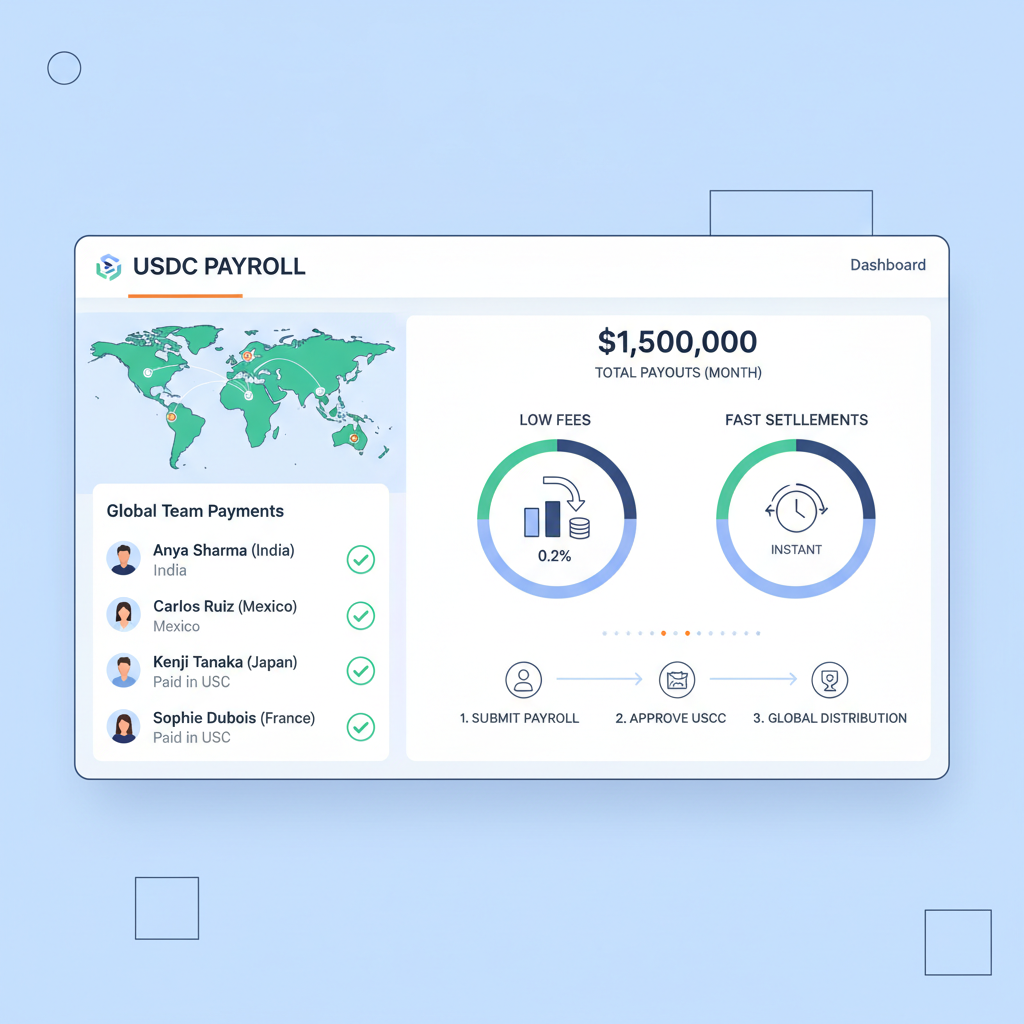


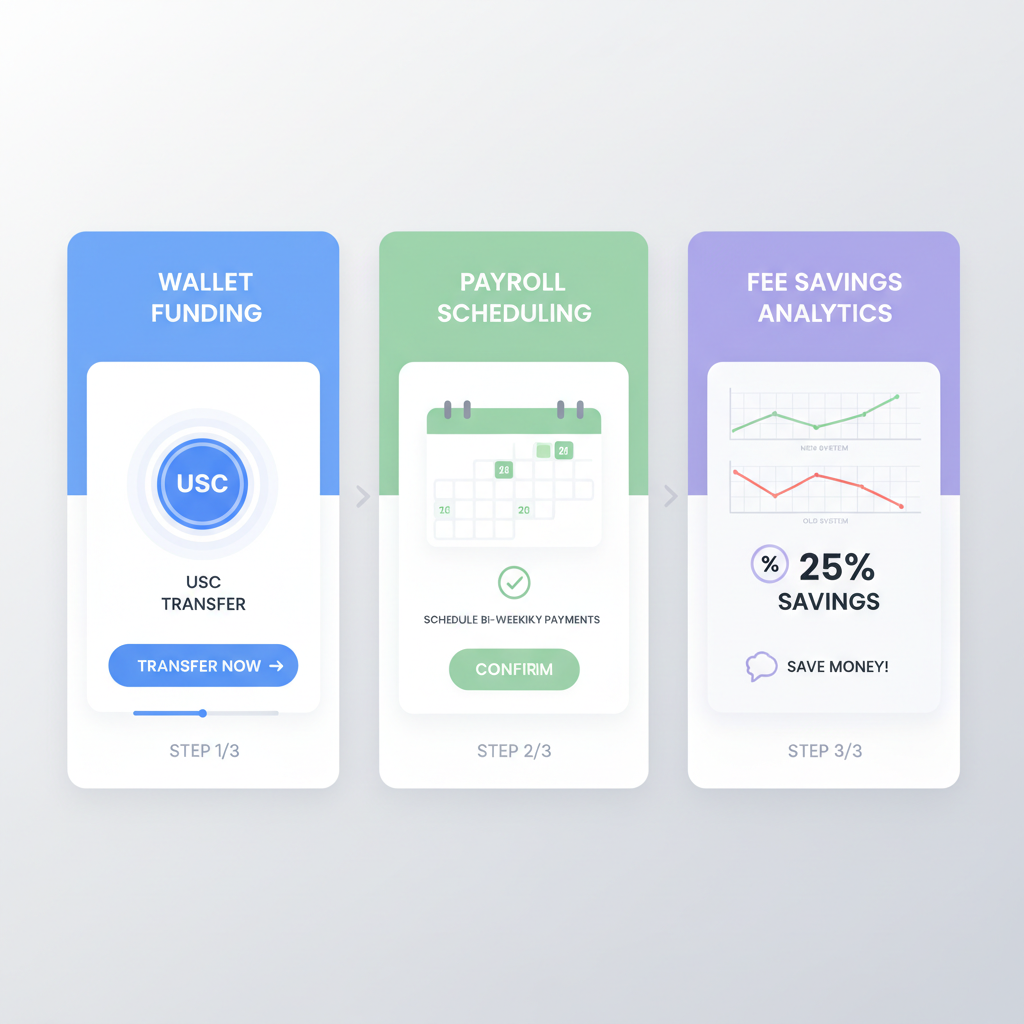
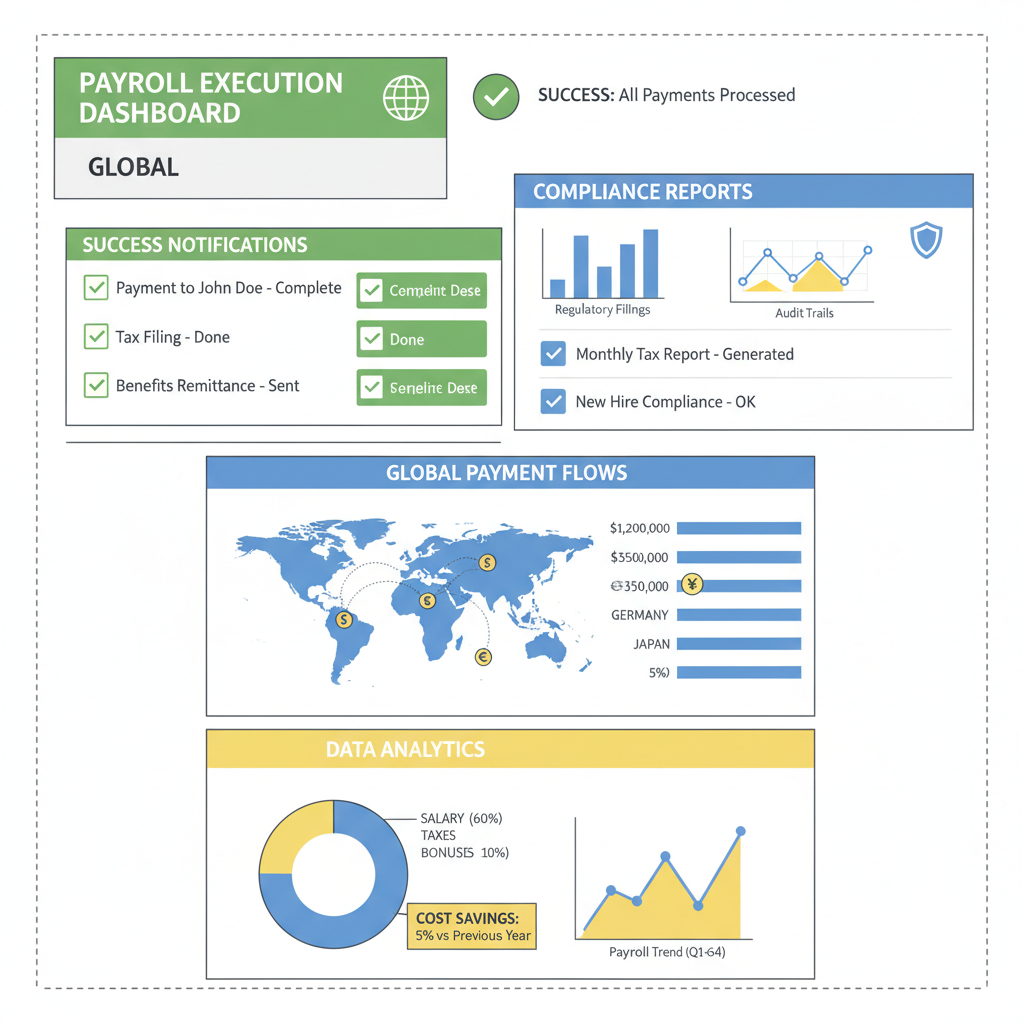
Detailed guides like this streamline adoption, often completing setup in hours. Real adopters report 80% fee cuts, per Riseworks, with settlements in seconds versus days. For a 50-person team, that’s $120,000 saved yearly on a $3 million payroll, redirected to R and amp;D or retention bonuses.
Quantified Wins and Future Projections
Benchmark against peers: traditional payroll volatility exposes firms to 1-3% annual erosion from FX swings; USDC locks at $1.00, its 24h range unyielding. Platforms quantify benefits – Toku cites sub-cent fees on Polygon, Remote logs 90% faster payouts. TransFi’s freelancer data mirrors this for contractors, scaling to full salaries.
Projections? With regulatory green lights post-2024, stablecoin payroll volumes could hit 10% of global remote pay by 2028, my analysis suggests, driven by USDC’s dominance. Cross-Border Payroll positions firms at this forefront, blending crypto efficiency with fiat familiarity. Teams in volatile markets like Argentina or Turkey gain most, cashing out stably without bank intermediaries.
OneSafe’s coverage of Remote’s pivot validates the momentum: fast, stable, borderless. Ogletree’s compliance lens confirms crypto payrolls maturing beyond hype into enterprise staples. For leaders eyeing crypto payroll global payments, the data converges – USDC isn’t just viable; it’s optimal, slashing FX fees while accelerating growth in a remote-first world.
About the Author