
As remote work cements its status in the global economy, the way companies pay distributed teams is undergoing a fundamental transformation. Traditional payroll rails are often slow, expensive, and intrusive, particularly for international teams navigating multiple currencies and regulatory frameworks. Enter stablecoin payroll: a system that leverages digital currencies pegged to assets like the US dollar to deliver fast, cost-effective, and borderless payments. Yet beyond efficiency and cost savings, a critical feature is emerging as a differentiator: privacy.
Why Privacy Matters in Global Payroll
For remote employees and contractors, privacy isn’t just about personal preference, it’s about safety and autonomy. In many countries, sharing sensitive financial details with banks or third parties can expose individuals to risks ranging from identity theft to government overreach. Traditional banking systems require extensive personal information for cross-border transfers, often leaving a detailed digital paper trail.
Stablecoin payroll systems disrupt this paradigm by allowing employees to receive salaries without disclosing excessive personal data. Transactions occur directly between employer and recipient wallets, minimizing data exposure. As noted by Remote and Stripe, this model is especially advantageous for contractors and freelancers who value discretion or operate in jurisdictions with unstable banking environments.
How Stablecoins Enhance Payroll Privacy
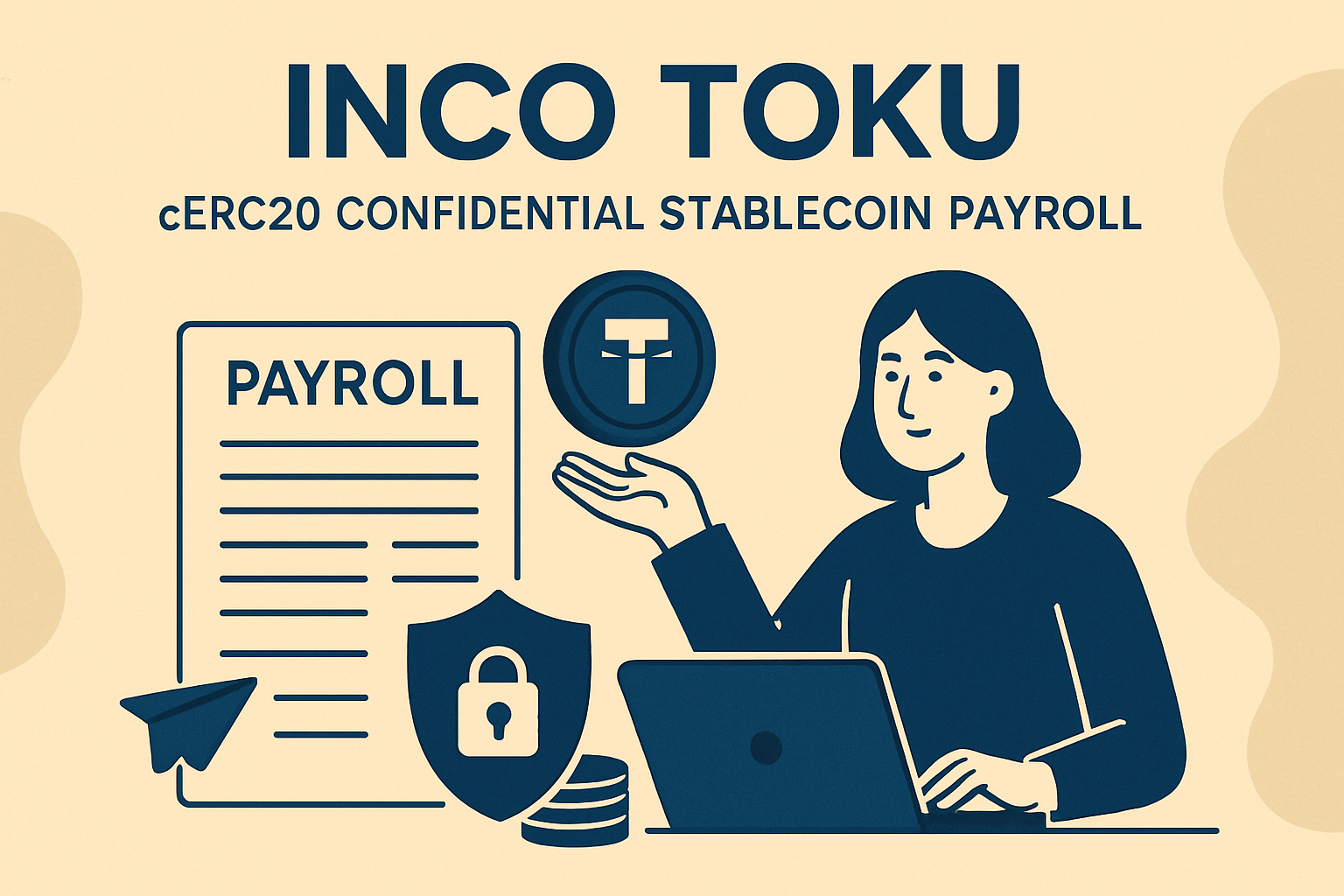
At the technical level, stablecoins such as USDC operate on public blockchains. This transparency provides an immutable audit trail, beneficial for compliance, but can inadvertently reveal transaction amounts and wallet addresses. To overcome this, innovative solutions like the cERC20 standard from Inco and Toku employ Fully Homomorphic Encryption (FHE). This advanced cryptography encrypts transaction data so that even though the transaction is validated on-chain, sensitive details remain confidential.
This balance between transparency and privacy is crucial. Employers can prove payments were made (satisfying compliance requirements) without exposing the specific amounts or recipient identities to the public. Employees enjoy the assurance that their financial data remains shielded from prying eyes, a significant upgrade over traditional wire transfers or SWIFT payments.
Key Benefits of Stablecoin Payroll Privacy for Remote Teams
5 Key Data-Driven Benefits of Confidential Crypto Payroll
- 1. Enhanced Privacy Through Encrypted TransactionsSolutions like Inco and Toku utilize the cERC20 standard with Fully Homomorphic Encryption (FHE) to keep payroll amounts and account balances confidential, ensuring sensitive employee data is never exposed on the blockchain.
- 2. Faster, Reliable Global PaymentsPlatforms such as Remote and Stripe enable instant stablecoin payouts to contractors worldwide, reducing delays and payment failures often seen in traditional banking systems.

- 3. Lower Fees and Reduced Currency Conversion CostsStablecoin payroll systems, as highlighted by Bitwage and TransFi, minimize transaction and FX fees, allowing remote teams to retain more of their earnings compared to conventional cross-border transfers.
- 4. Secure, Tamper-Proof Audit TrailsEach stablecoin payroll transaction is recorded on a decentralized ledger, providing a transparent yet privacy-preserving audit trail that reduces fraud risk, as noted by Mural Pay.

- 5. Improved Accessibility in Unstable EconomiesPlatforms like OneSafe demonstrate that stablecoin payroll offers faster, more reliable payments in regions with volatile local currencies, helping remote workers hedge against inflation and economic instability.

Privacy-preserving stablecoin payroll systems are redefining what it means to work globally. Consider these advantages:
- Reduced Data Exposure: No need to share sensitive banking details with every payment.
- Protection from Local Instability: Workers in high-risk jurisdictions avoid unnecessary scrutiny.
- Mitigated Identity Theft: Less personal data circulating means fewer opportunities for bad actors.
- Streamlined Onboarding: Contractors can receive payments with just a wallet address, no lengthy KYC required.
- Autonomy and Control: Employees can manage their funds privately, outside the constraints of legacy banks.
These privacy gains come alongside the established advantages of stablecoins: instant settlement, negligible FX fees, and global reach. As platforms like Toku roll out encrypted payroll protocols, the future of work looks not just more flexible, but more private by design.
Privacy in payroll is not a luxury for remote teams, it is rapidly becoming an operational necessity. The expansion of stablecoin payroll privacy features is directly addressing the vulnerabilities exposed by both legacy financial systems and public blockchains. By decoupling personal identity from financial transactions, global teams gain a measurable layer of security that is particularly valuable in volatile or surveilled markets.
Compliance Without Compromise: USDC Payroll and Regulatory Trends
One of the most persistent myths is that privacy and compliance are mutually exclusive. In reality, modern stablecoin payroll solutions are engineered to deliver both. For example, USDC payroll compliance frameworks allow companies to document and report payroll activity for regulatory purposes, while simultaneously leveraging privacy-preserving technologies to keep sensitive data out of public view. This dual approach is essential for companies operating across multiple jurisdictions with varying data protection laws.
Platforms like Remote and Stripe have demonstrated that stablecoin payroll can be both compliant and confidential, setting new benchmarks for how global payroll should function. The cryptographic audit trails provided by solutions like cERC20 enable transparent reporting for tax and legal purposes, while FHE ensures that only authorized parties can access granular transaction data. This is a foundational shift for confidential crypto payroll and private blockchain payroll models.
Real-World Adoption: How Teams Are Using Confidential Crypto Payroll
Early adopters in fintech, AI, and software engineering sectors are already reaping the benefits of confidential crypto payroll. Teams distributed across Latin America, Eastern Europe, and Southeast Asia have reported fewer payment delays and reduced exposure to local banking disruptions. For many, the ability to receive stablecoin salaries directly into a secure wallet, without navigating cumbersome international wire transfers, is transformative.
Consider a developer based in Argentina or Turkey. Receiving USDC via a privacy-enhanced protocol means insulating their income from local currency devaluation while avoiding the intrusive documentation required by traditional banks. In unstable economies, this can be the difference between financial resilience and vulnerability.
Best Practices for Implementing Stablecoin Payroll Privacy
Transitioning to a private stablecoin payroll system is not plug-and-play. It requires careful vendor selection, regulatory review, and clear communication with global staff. Here are some best practices:
- Choose a platform that supports encrypted transactions (e. g. , cERC20 or similar standards).
- Ensure integration with existing HR and accounting workflows for seamless reporting.
- Educate employees on wallet security and privacy features.
- Regularly audit compliance with both local and international regulations.
By following these steps, companies can build trust with their remote teams while future-proofing their payroll operations against both regulatory and technological shifts.
The evolution of stablecoin payroll privacy is more than a technical upgrade, it is a strategic advantage for globally minded organizations. As cryptographic privacy features continue to mature, expect adoption to accelerate well beyond tech-forward sectors. For teams seeking both efficiency and discretion in cross-border payments, private blockchain payroll is quickly becoming the gold standard.
No comments yet. Be the first to share your thoughts!